
The Profitability Benchmark You Won’t Find in the FDD: Why Only 1 in 2 Boutique Studios Actually Make Money
91.2% of boutique fitness studios lack sustainable profitability. The question isn’t whether Hotworx is a good franchise — it’s whether its specific model beats odds that destroy most operators.
The Number That Changes the Conversation
You’ve read the FDD. You’ve modeled the $351K average revenue from Item 19. You’ve calculated break-even at 250–300 members. Everything looks reasonable on paper.
Now consider this: according to 2026 industry data, only approximately 1 in 2 boutique fitness studios are actually cash-flow positive. And of those that are cash-flow positive, only 8.8% achieve what researchers classify as “sustainable profitability” — meaning they cover not just operating expenses but also owner salary replacement, equipment depreciation reserves, and lease escalation without requiring the owner to subsidize the business with below-market compensation.
These aren’t failure-rate statistics about studios that closed. These are OPERATING studios. Open doors, lights on, members working out — and still not making the owner real money.
The FDD doesn’t disclose this industry context. It shows you Hotworx’s revenue figures without showing you the survival rate of the broader category you’re entering.
What’s Killing Boutique Studio Profitability
The industry-wide profitability crisis has identifiable structural drivers. Understanding them tells you exactly where to look for Hotworx’s potential advantage — or vulnerability.
The Labor Trap
Traditional boutique studios employ 8–12 people: instructors, front desk, cleaning, management. Instructor compensation alone often consumes 25–35% of revenue. The industry-wide instructor shortage (1 qualified instructor available per 3 open positions) has created wage inflation. Studios that can’t match rising instructor demands lose their talent — and their members follow.
Hotworx structural difference: 2–3 total employees per studio. Virtual instruction eliminates the instructor payroll line entirely. No instructor shortage risk. No wage-and-hour litigation exposure on per-class compensation (the issue that generated $36M+ in settlements against Equinox alone).
Labor cost as percentage of revenue for a typical Hotworx studio: 15–20%.
Labor cost as percentage of revenue for a typical boutique competitor: 30–40%.
That’s a 15–20 percentage point structural margin advantage on the single largest variable expense category.
The Square Footage Problem
The median boutique studio is 2,500–4,000 sq ft. At $25–40/sq ft NNN in desirable retail locations, base rent runs $62,500–$160,000 annually — before CAM charges, insurance, and lease escalations.
Hotworx structural difference: 1,000–1,500 sq ft typical footprint. Same strip-center locations but 40–60% less space. Annual rent typically $25,000–$60,000.
More importantly: Hotworx’s revenue per square foot is comparatively dense because the sauna pods create a high-capacity model in minimal space. A 1,200 sq ft Hotworx with 8–10 pods running simultaneously during peak hours can serve as many members per hour as a 3,000 sq ft group class studio.
The Royalty Compression
Percentage-based royalties (standard in boutique fitness: 5–8% of gross revenue) punish top performers. A studio generating $500K pays $25K–$40K in royalties. A studio generating $750K pays $37.5K–$60K — an additional $12.5K–$20K for the same franchisor support.
Hotworx structural difference: Flat $399/month royalty regardless of revenue. At $351K average revenue, that’s 1.4% effective royalty rate. At $500K revenue, it drops to 0.96%. This is a genuine structural advantage that scales with performance.
The Churn Cost
The average boutique studio replaces its entire membership base approximately every 13 months (~7.5% monthly churn). Every churned member represents a fully-loaded member acquisition cost (typically $80–150 in digital marketing + sales labor + free-trial costs) that must be re-spent just to maintain flat revenue.
Hotworx structural comparison: Hotworx’s 24-hour unmanned model with no live-class social bonds may experience HIGHER churn than instructor-led competitors (the community-retention paradox). But its member acquisition cost may be LOWER due to simpler sales process (no class scheduling complexity, no instructor-personality matching). Net effect: unclear advantage. This is the one category where Hotworx’s model may not beat the industry baseline.
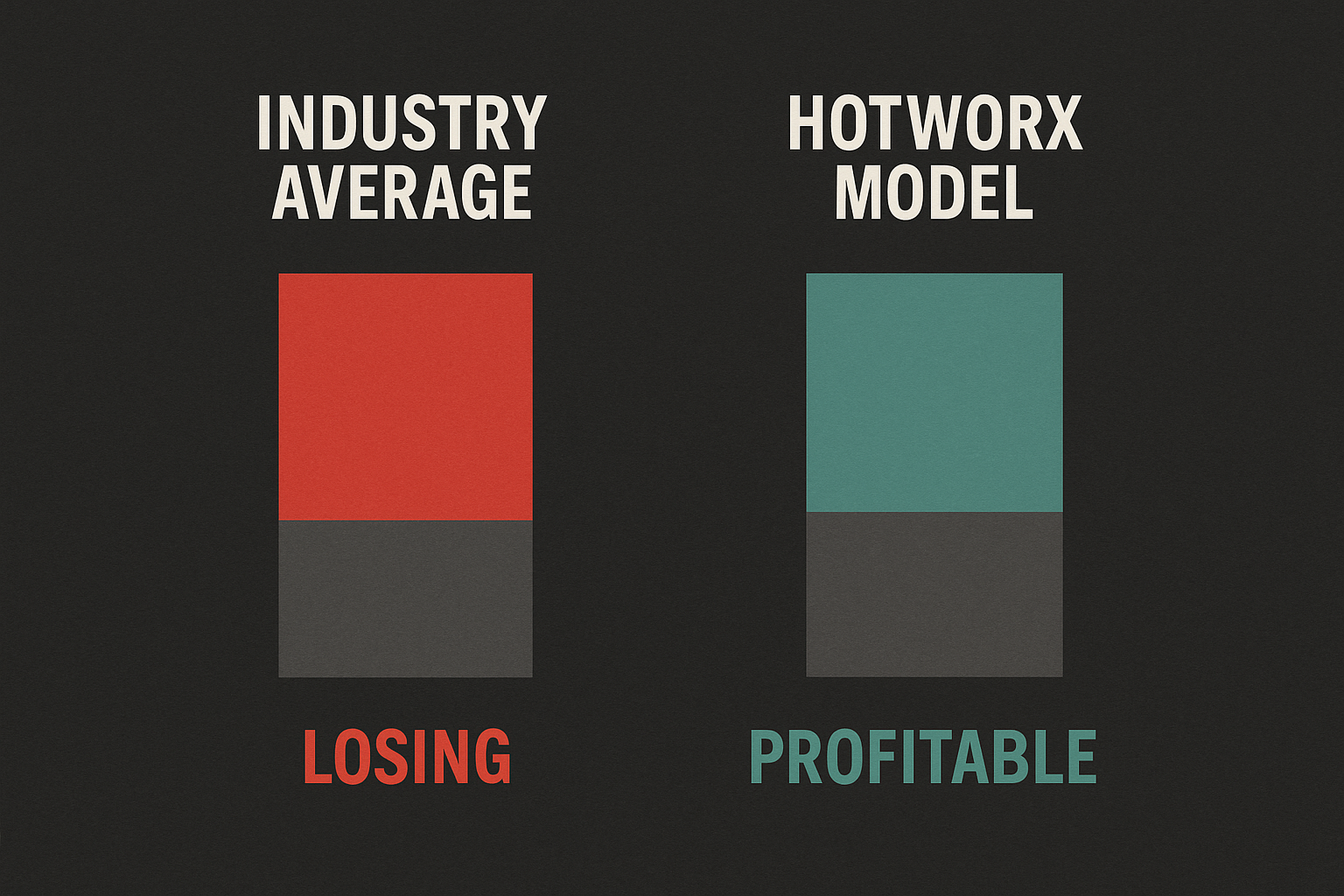
The Profitability Math: Hotworx vs. Industry Average
Let’s model a comparison at the $351K revenue level (Hotworx Item 19 average):
Typical Boutique Studio at $351K Revenue
| Category | Amount | % Revenue |
|---|---|---|
| Rent (3,000 sq ft) | $90,000 | 25.6% |
| Labor (8 people, instructor-heavy) | $122,850 | 35.0% |
| Royalty (6% of gross) | $21,060 | 6.0% |
| Marketing (member replacement) | $35,100 | 10.0% |
| Utilities/maintenance | $24,570 | 7.0% |
| Insurance/misc operating | $17,550 | 5.0% |
| Total expenses | $311,130 | 88.6% |
| Owner cash flow | $39,870 | 11.4% |
At $39,870 pre-tax, pre-debt-service — this studio is technically “profitable” but the owner is earning less than a shift manager. After SBA loan payments ($2,500–3,500/month), the owner may be cash-flow negative. This is the “profitable but not sustainably profitable” category that makes up roughly 40% of operating studios.
Hotworx Studio at $351K Revenue
| Category | Amount | % Revenue |
|---|---|---|
| Rent (1,200 sq ft) | $42,000 | 12.0% |
| Labor (2–3 people) | $63,180 | 18.0% |
| Royalty (flat $399/mo) | $4,788 | 1.4% |
| Marketing (member acquisition) | $35,100 | 10.0% |
| Utilities (infrared = higher/sq ft) | $21,060 | 6.0% |
| Technology/equipment maintenance | $14,040 | 4.0% |
| Insurance/misc operating | $14,040 | 4.0% |
| Total expenses | $194,208 | 55.3% |
| Owner cash flow | $156,792 | 44.7% |
The structural advantage is stark: at identical revenue, the Hotworx model produces nearly 4x the owner cash flow.
Why the Advantage Isn’t Guaranteed
Before you celebrate the math above, consider what the model doesn’t capture:
The Revenue Question
The comparison assumes identical $351K revenue. But Hotworx’s $59/month price point means you need ~496 active members at full price to hit $351K. A boutique studio charging $150–200/month needs only 146–195 members for the same revenue. Lower price = higher volume requirement = harder to achieve in competitive markets.
The Utilization Ceiling
Hotworx studios have finite sauna pods (typically 8–12). Each pod serves 1–3 members per session, with sessions running 15–40 minutes. There is a physical capacity ceiling that instructor-led group classes (25–40 per class) don’t face. At scale, the small-footprint advantage becomes a capacity constraint.
The Marketing Equivalence Assumption
The model above assumes equal marketing spend. In practice, a concept that generates less organic word-of-mouth (no instructor community, no post-class social bonding) may require MORE marketing spend to maintain equivalent member acquisition rates. If Hotworx’s actual marketing cost is 12–15% of revenue rather than 10%, the margin advantage narrows.
The Equipment Depreciation Reality
Infrared saunas are specialized capital equipment with 5–7 year useful life before major refurbishment. The annual depreciation reserve ($12K–$18K) isn’t in the operating expense model above but should be.
How to Use This Benchmark in Your Due Diligence
Step 1: Get the Real Profitability Number From Validation Calls
When speaking with existing franchisees (Item 20 contacts), don’t ask “are you profitable?” — everyone says yes. Ask:
- “What was your total owner compensation last year including salary, distributions, and any personal expenses run through the business?”
- “What’s your monthly debt service payment and is it covered by operations or supplemented personally?”
- “If you sold today at a fair price, would you have earned a better return on your invested capital than the S&P 500?”
Step 2: Benchmark Against the 50% Line
If fewer than 60–70% of the franchisees you speak with are achieving genuine owner salary replacement (not just “cash flow positive before my own time”), the system may be performing near the industry average — despite its structural advantages.
Step 3: Model Your Specific Market’s Impact
The structural advantages above are real but apply to the MODEL. Your specific studio’s profitability depends on local factors:
- What’s the actual rent per square foot in your target market?
- What’s the minimum viable staffing cost given your state’s minimum wage?
- What’s the competitive marketing environment? (More infrared competitors = higher CAC)
Step 4: Understand What “Sustainable” Means
A studio generating $80K in annual owner cash flow is profitable. But is it SUSTAINABLY profitable? Test against:
- Does it cover your SBA debt service (~$30K–$42K/year)?
- Does it replace your prior salary?
- Does it justify the $300K+ at-risk capital versus alternative investments?
- Does it survive a 20% revenue decline without going cash-flow negative?
If your model requires top-quartile revenue performance to achieve sustainable profitability, you’re betting on being exceptional in an industry where the majority of operators fail financially.
The Lender’s Lens: What Lenders Evaluate
Franchise lenders see hundreds of boutique fitness applications annually. They know the industry profitability statistics even if franchisors don’t disclose them. When underwriting your Hotworx loan, SBA lenders apply a debt service coverage ratio (DSCR) test of 1.1:1 or greater — meaning your projected cash flow must exceed your loan payments by at least 10%.
Understanding how your specific market and unit economics compare to industry benchmarks isn’t just an investment exercise — it’s what determines whether your loan application gets approved. Lenders who specialize in franchise financing can help you stress-test your model against these industry realities before you commit capital.
The Bottom Line
Hotworx’s model has genuine structural advantages over the typical boutique studio: lower labor, smaller footprint, flat royalty. These advantages are real and mathematically significant. At identical revenue, a Hotworx studio should produce substantially better owner economics than the industry average.
But “better than the industry average” is a low bar when the industry average is unprofitable. The relevant question isn’t whether Hotworx beats other boutique concepts structurally — it probably does. The question is whether YOUR specific studio, in YOUR specific market, at YOUR specific revenue level, achieves not just profitability but sustainable profitability that justifies a $300K+ bet and a 10-year commitment.
Model the downside. Benchmark against the 50% failure line. Make the decision with open eyes.
Half of all boutique studios don’t make real money for their owners. That’s not a scare statistic — it’s the baseline against which every franchise investment should be evaluated. Know exactly why yours will be different.