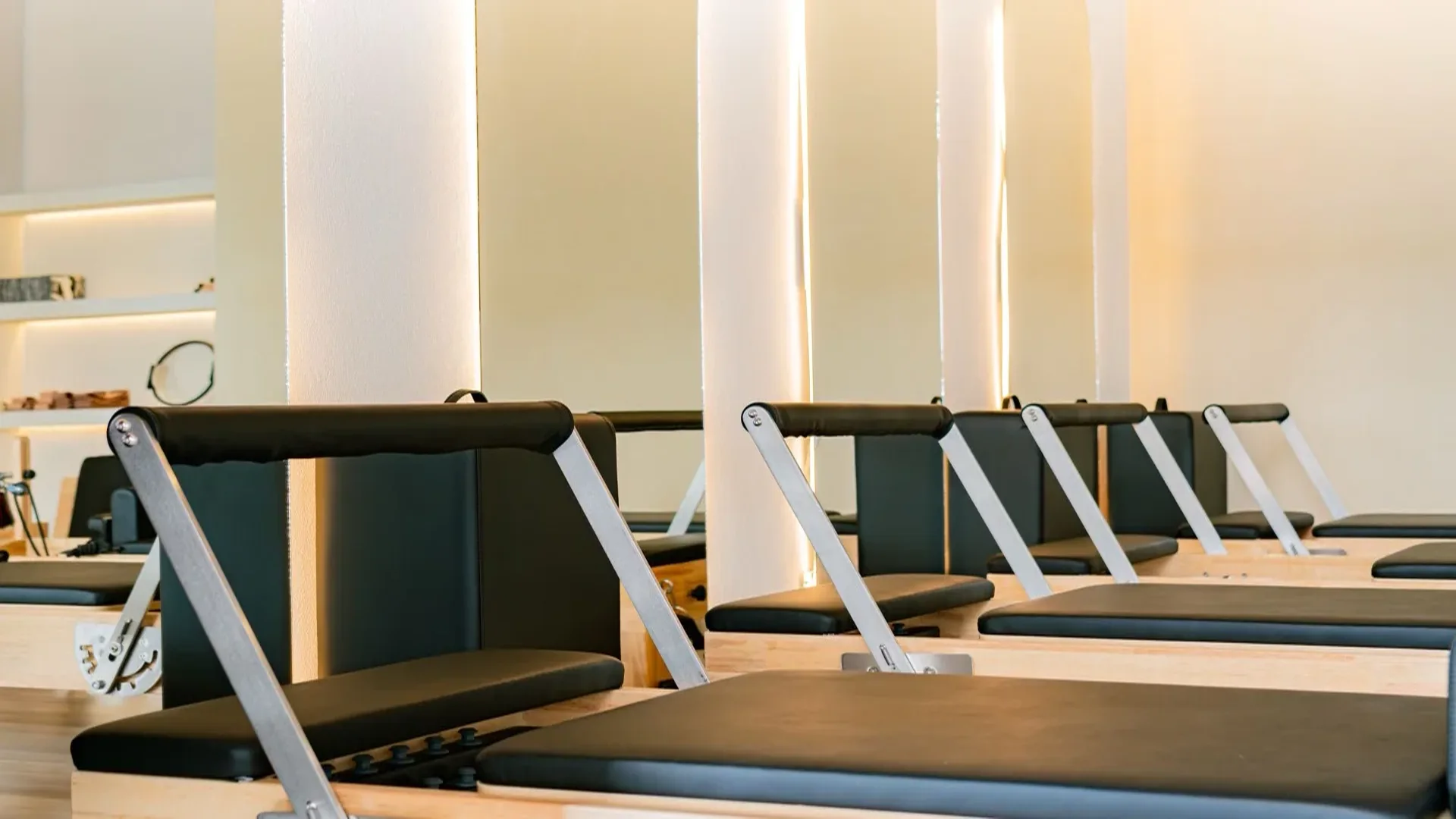
Club Pilates Studio Setup
Total estimated initial investment of $385,048–$839,058 (Item 7, 2025 FDD) — covering reformers, leasehold improvements, technology, signage, and working capital for a boutique fitness studio built around group reformer classes.
Investment Range Breakdown
The $385,048–$839,058 range disclosed in Item 7 of the 2025 FDD covers the full cost of opening a single Club Pilates studio. That is a wide spread — the ceiling is more than double the floor — and the variation is driven primarily by three factors: the cost of leasehold improvements in the chosen market, the size and configuration of the studio, and whether the franchisee opts for additional equipment beyond the standard package.
The major line items inside that range break down as follows:
- Initial franchise fee: $65,000 (Item 5, 2025 FDD). This is a fixed cost, identical for every new studio.
- Leasehold improvements: The largest variable in the budget. A turnkey second-generation retail space in a secondary market may need $80,000–$120,000 in improvements. A first-generation build in a primary metro can run $200,000 or more, depending on the condition of the shell, HVAC requirements, and local permitting costs.
- Equipment — reformers: The reformer package is the single largest equipment line item. A standard Club Pilates studio runs 10–12 Balanced Body reformers. Each unit, with the box, pad set and accessories, runs in the range of $3,500–$5,000 at institutional pricing. At 12 units, that is $42,000–$60,000 for reformers alone.
- Equipment — ancillary: Beyond reformers, the class format uses springboards, EXO chairs, TRX suspension trainers, Bosu balls, mats, resistance bands, and smaller props. This ancillary package typically runs $15,000–$30,000.
- Signage and branding: Interior and exterior signage, branded wall graphics, wayfinding — typically $10,000–$25,000 depending on the landlord’s requirements and local sign ordinances.
- Technology: Point-of-sale system, booking software, sound system, display screens, Wi-Fi infrastructure. The booking platform is Xponential’s proprietary system, and the cost of onboarding is included in the technology line.
- Working capital and additional funds: Item 7 includes a three-month working capital estimate. This covers rent, payroll, marketing and operating expenses before the studio reaches a sustainable membership base. The range reflects wide variation in local rent and staffing costs.
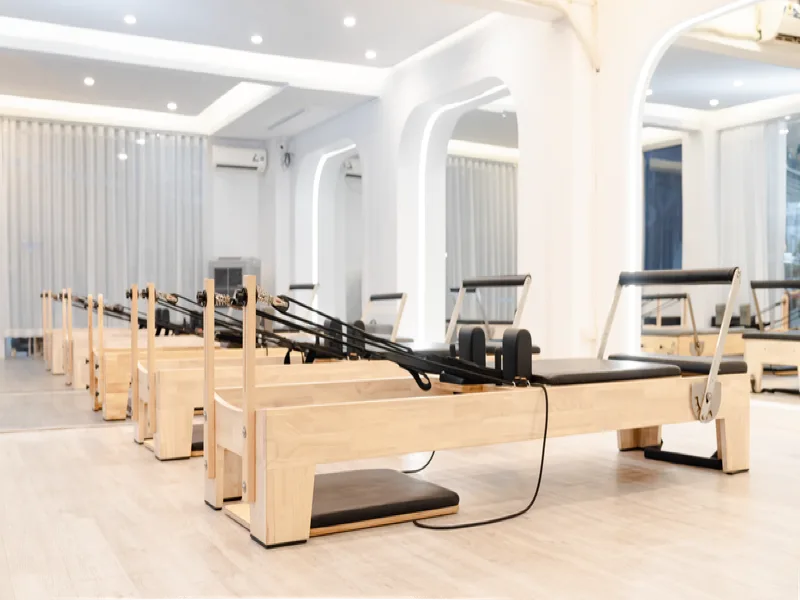
The reformer is the business. A Club Pilates class is built around the reformer — it is the piece of equipment that differentiates the format from mat Pilates, yoga and barre. The quality, maintenance and replacement cycle of the reformer fleet directly determines the class experience and, by extension, member retention.
Real Estate Requirements
A typical Club Pilates studio occupies 1,800–2,500 square feet of ground-floor retail space. The format needs open floor area for a reformer room large enough to accommodate 10–14 machines in rows with adequate aisle width, a small reception area, a retail display zone, restrooms, and a storage or laundry area. The layout is constrained by the reformer footprint — each unit occupies roughly 8–9 feet of length and needs 3–4 feet of lateral clearance for class movement.
Lease terms for boutique fitness studios in strip malls and mixed-use retail centres typically run 5–10 years with renewal options. Landlords in fitness-friendly centres may offer tenant improvement allowances (TI) of $20–$50 per square foot, which directly offsets the leasehold improvement line in Item 7. Securing a strong TI package is one of the most significant financial levers available to a new franchisee, because it compresses the gap between the low and high end of the investment range.
Build-out timelines vary significantly by market and building condition. Xponential has publicly represented typical timelines to franchisees, and this is one of the areas addressed by the FTC’s enforcement action.
The FTC and Time-to-Open
On 18 March 2026, the Federal Trade Commission announced a proposed stipulated order against Xponential Fitness, Club Pilates’ parent company, alleging Franchise Rule violations. Among the FTC’s allegations was that Xponential “represented, directly or indirectly, expressly or by implication” that franchisees could expect to open their studios within approximately six months of signing their franchise agreement.
The FTC alleged that, in reality, the typical time from signing to opening was substantially longer than six months — and that some franchisees never opened at all. The proposed order’s language is blunt: the FTC alleged the representation was misleading because the typical experience was over a year “if they opened at all.”
This is an allegation in a proposed stipulated order, not an adjudicated finding of fact. Xponential agreed to the settlement without admitting or denying the allegations. But the allegation itself is relevant to any prospective franchisee’s build-out planning: if the regulator believed the six-month timeline was materially misleading, a conservative financial model should budget for 12–18 months of pre-revenue carrying costs, not six.
That longer runway has direct financial consequences. Every month between lease signing and studio opening is a month of rent, insurance and loan service with no revenue. At a monthly rent of $4,000–$8,000 for a 2,000-square-foot retail space, six additional months of pre-revenue occupancy adds $24,000–$48,000 to the effective cost of opening — costs that sit outside the Item 7 estimate because the FDD assumes the franchisee’s own timeline for securing and building out a site.
Equipment Deep Dive: Reformers, Class Capacity and the Expanded Studio Signal
The standard Club Pilates studio configuration runs 10–12 reformers. That number directly sets the class capacity ceiling: a 12-reformer studio running a single class accommodates 12 participants plus the instructor. At six to eight classes per day, six days a week, that is a theoretical maximum of roughly 430–575 class slots per week before accounting for utilisation rates, cancellations and off-peak scheduling.
In practice, utilisation rates for boutique fitness studios typically run 55–75% of theoretical capacity, depending on the market, the time-of-day mix, and how aggressively the studio prices off-peak slots. A 12-reformer studio at 65% utilisation averages roughly 280–375 filled slots per week — and that throughput, multiplied by the effective revenue per visit (a blend of membership and class-pack pricing), determines the studio’s revenue ceiling.
This is where the 2025 FDD offers an interesting data point. Item 19 discloses a subset of “Expanded Studios” — 11 studios operating with more than 12 reformers. These larger-format locations reported average gross revenue of $1,477,615 (2024, per the 2025 FDD), compared to the $984,270 average across the full 849-studio qualified set.
| Studio Format | Studios in Sample | Avg. Gross Revenue | Defining Feature |
|---|---|---|---|
| Standard studios (all qualified) | 849 | $984,270 | 10–12 reformers |
| Expanded studios | 11 | $1,477,615 | >12 reformers |
The Expanded Studio average is roughly 50% above the network mean. The sample is small — 11 studios is not statistically robust, and there is an obvious selection effect: studios that expanded likely did so because they were already performing well in strong markets. The data does not prove that adding reformers causes higher revenue. But it does signal something about the relationship between capacity and revenue ceilings.
A 12-reformer studio has a hard physical limit on throughput. No amount of marketing, pricing optimisation or scheduling software can push more than 12 people through a class. The only ways to grow revenue past that ceiling are: raise prices, add class times (which hits diminishing returns as off-peak slots fill poorly), or add machines. The Expanded Studio cohort suggests that the third option — expanding the reformer count — meaningfully lifts the revenue ceiling for studios that have saturated their existing capacity.
For a prospective franchisee, this creates a site-selection tension. A smaller, cheaper space locks in a lower investment but also locks in a lower revenue ceiling. A larger space with room for 14–16 reformers costs more upfront — pushing toward the high end of the Item 7 range or beyond it — but preserves the option to scale into higher throughput without relocating. Given that a studio relocation mid-lease is prohibitively expensive and operationally disruptive, the space decision is largely irreversible.
Equipment Lifecycle and Replacement
Reformers are mechanical devices under daily high-repetition load. Springs fatigue, carriages wear, upholstery degrades with sweat exposure. A well-maintained Balanced Body reformer has an expected service life of roughly 8–12 years before major refurbishment or replacement is warranted, though springs and straps are consumable items replaced on a shorter cycle.
At a fleet of 12 reformers with a 10-year replacement cycle, a studio should budget $4,200–$6,000 per year in depreciation against its equipment line — a figure that rarely appears in franchise marketing materials but sits squarely in the operating P&L. Spring and strap replacement, upholstery re-covering and carriage maintenance add another $1,500–$3,000 annually in routine maintenance costs.
The ancillary equipment — springboards, chairs, TRX rigs — has a shorter useful life and lower per-unit replacement cost. Mats, bands and small props are essentially consumable, replaced quarterly or as they show wear. A disciplined operator budgets 2–3% of gross revenue annually for total equipment maintenance and replacement across the full inventory.