The 1.9x Question: What Club Pilates’ Quartile Spread Actually Tells You About Revenue Predictability
Club Pilates discloses more revenue data than most franchise systems. The gap between its top and bottom quartile is unusually narrow. That matters for your underwriting — and it has limits.
Most franchise FDDs give you an average and leave you guessing. Club Pilates’ 2025 FDD (reporting 2024 results for 849 qualified studios) breaks revenue into quartiles, and the spread tells a story that the topline average obscures.
The top quartile averaged $1,305,116. The bottom quartile averaged $686,457. That is a 1.9x ratio — the best-performing quarter of studios produced roughly twice the revenue of the worst-performing quarter.
In franchise due diligence, that number is your starting point for revenue predictability. A tight spread means less location lottery. A wide one means the system has winners and losers, and the FDD average tells you about neither.
How Tight Is 1.9x, Really?
Context matters more than the raw number. Compare Club Pilates’ quartile spread to other franchise systems that disclose Item 19 data:
- Club Pilates: 1.9x (top quartile $1,305,116 vs. bottom quartile $686,457; 2024, per the 2025 FDD)
- Goddard School: 11.2x spread across disclosed performance tiers (Goddard FDD analysis)
That comparison is not perfectly apples-to-apples — Goddard is a childcare center with six-figure tuition revenue per family, and variations in capacity, real estate, and local demographics create wider swings. But the magnitude of the difference is instructive: Club Pilates studios cluster around a band, while some franchise systems span an order of magnitude.
A few things drive that clustering:
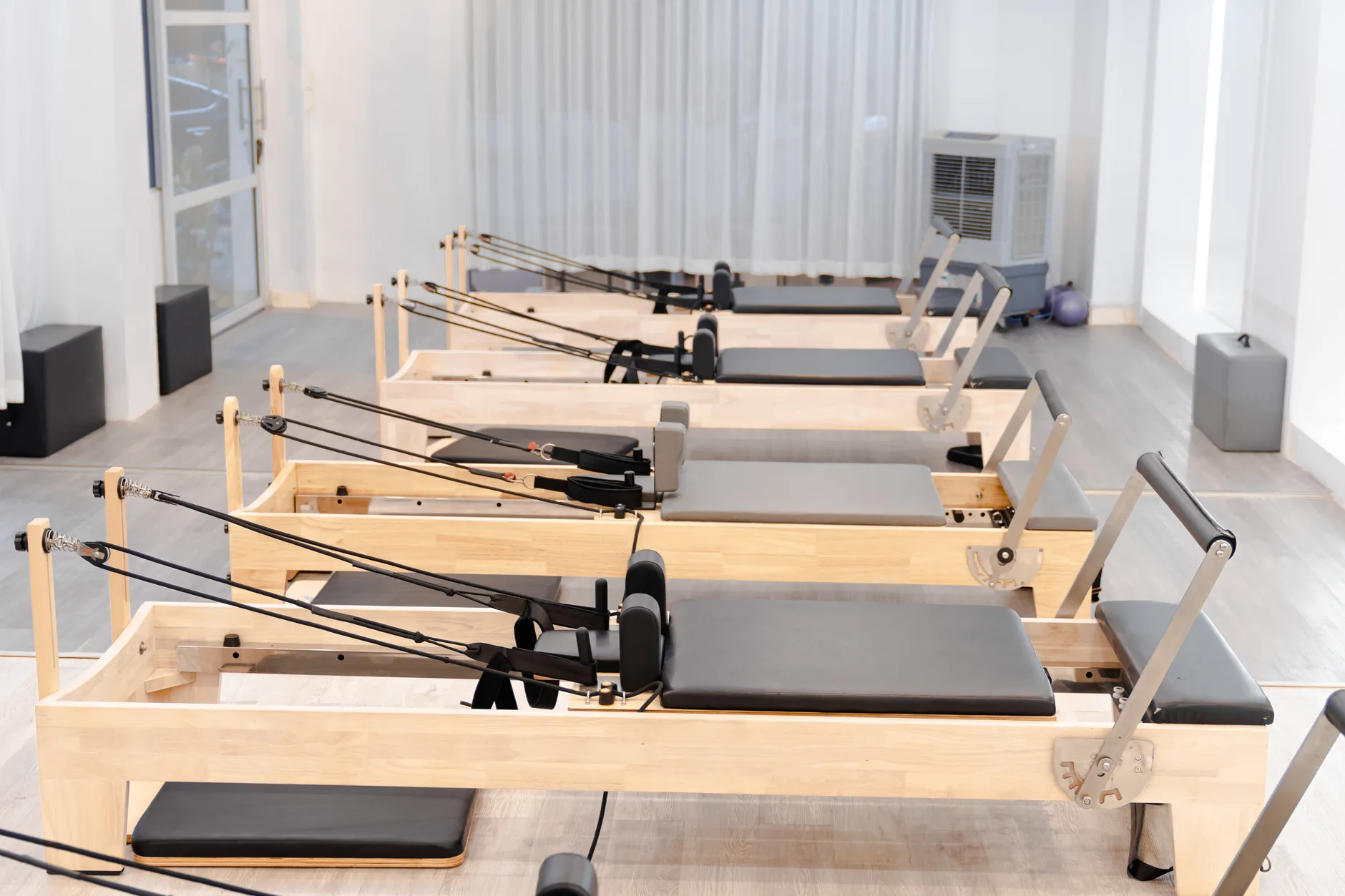
- Standardized format. A Club Pilates studio is 1,800–2,400 square feet with a fixed reformer count. You cannot build a double-size location or shrink into a micro-format. The physical cap constrains both upside and downside.
- Membership model. Revenue is largely recurring monthly memberships, not one-time transactions. That smooths variance month to month and location to location.
- Class capacity ceiling. Each reformer serves one member per class. At 10–12 reformers per studio, there is a hard throughput limit that even the best operator cannot exceed without expanding — and only 11 studios in the system have done so.
Those 11 Expanded Studios (more than 12 reformers) averaged $1,477,615 in 2024, per the 2025 FDD. They are excluded from the main Item 19 table, which is worth noting: the studios with the most physical capacity are not in the numbers above.
The Full Quartile Picture
Here is the complete Item 19 breakdown for 849 qualified studios in 2024, per the 2025 FDD:
| Quartile | Average Revenue | Median Revenue |
|---|---|---|
| All qualified (849 studios) | $984,270 | $969,022 |
| Q1 (top 25%) | $1,305,116 | $1,261,234 |
| Q2 | $1,051,803 | $1,048,027 |
| Q3 | $894,131 | $894,375 |
| Q4 (bottom 25%) | $686,457 | $713,766 |
Two things jump out.
The averages and medians are close. In every quartile, the mean and median are within a few percent of each other. That tells you the distribution within each quartile is not skewed by outliers. Q4’s median ($713,766) is actually higher than its average ($686,457), which means a handful of studios at the very bottom are pulling the average down, but the typical bottom-quartile studio does better than the average suggests.
The middle is wide. Q2 and Q3 together span $894,131 to $1,051,803 — a $157,672 range that covers half the system. If you land in the middle half, your revenue is somewhere around $950K. That is a useful number for financial modeling.
What “Qualified” Means and Why It Matters
“Qualified Studios” in the 2025 FDD means franchisee-owned locations that were open for the entire 2024 calendar year, excluding non-traditional sites and Expanded Studios.
That definition excludes:
- Studios that opened during 2024. A studio that opened in March 2024 had only nine months of revenue but is not in the data. This matters because Club Pilates added roughly 160 franchised locations in 2024 alone (growing from 868 to 1,029 franchised units, per the 2025 FDD). Those new studios — many still in their ramp year — are invisible in Item 19.
- Non-traditional locations. Studios in hotels, corporate campuses, or other embedded formats operate under different economics.
- Expanded Studios. The 11 locations with more than 12 reformers are broken out separately.
The 849 qualified studios are the system’s mature, standard-format core. They are the right basis for modeling a new standard studio — but understand that you are looking at survivors. A studio that opened and closed within a year is not in this data. Neither is one that converted to an Expanded format because it outgrew the standard model.

The Floor Is the Number That Matters
A 1.9x spread sounds reassuring. But the question is not how tight the spread is. The question is whether the floor works.
The bottom quartile averaged $686,457 in 2024 revenue. Run the fee load against that:
- Royalty (8%): $54,917
- Brand development fund (2%): $13,729
- Local advertising (~2%): ~$13,729
- Total fee load (~12%): ~$82,375
That leaves $604,082 before rent, labor, equipment leases, insurance, utilities, and debt service. For a studio with a total initial investment of $385,048 to $839,058 (Item 7, 2025 FDD), the bottom quartile is serviceable but not comfortable — particularly at the upper end of the investment range.
The fee structure analysis covers this in detail, but the summary: at $686K revenue, the 12% fee load takes $82K off the top. Rent in a retail strip center runs $3,000–$6,000/month depending on market. Two to three instructors plus a studio manager is another $120K–$180K annually. Those three line items alone — fees, rent, and labor — can consume $250K–$320K of that $686K.
That leaves $366K–$436K for everything else: equipment leases, insurance, utilities, supplies, marketing above the required minimum, loan payments, and owner compensation. It is a living, but it is not the return profile that the system average of $984,270 implies.
The Growth Curve Adds Context
Club Pilates has grown steadily: 660 franchised units in 2021, 753 in 2022, 868 in 2023, 1,029 in 2024 (per successive FDDs). That is a system adding 100–160 locations per year. The SBA’s franchise lending data shows Club Pilates as one of the more actively financed franchise brands.
Rapid unit growth in a membership-based business creates a specific dynamic: new studios in the same metro area split the addressable market. A second Club Pilates in a city does not double the city’s Pilates demand — it divides the existing demand pool and grows it incrementally. Whether that helps or hurts your specific location depends on whether the new studio is three miles away or thirty.
The 2025 FDD does not disclose same-studio revenue trends, so you cannot tell from Item 19 alone whether the 849 qualified studios grew, shrank, or held flat individually. The quartile data is a single-year snapshot: 2024 revenue for studios that were open all of 2024.
The 2026 Context — These Numbers Are One Year Old
The Item 19 data describes 2024 — a year when Club Pilates’ parent company, Xponential Fitness, was still publicly traded and reporting growth. The landscape shifted in 2026.
Xponential reported same-store sales declining 5% for Club Pilates and 6.8% across the portfolio in Q2 2026, with consolidated revenue down 13% year over year. The company disclosed that it was exploring strategic alternatives, including a potential sale. The FTC’s proposed stipulated order — alleging Franchise Rule violations across five Xponential brands including Club Pilates — added regulatory uncertainty. Xponential admitted nothing in the settlement.
None of this changes the 2024 data. The 849 studios reported what they reported. But it means you should not project 2024 quartile figures forward without adjustment. A system where same-store sales are declining 5% and the parent is exploring a sale is not in the same posture as one growing into new markets.
If the Q2 2026 trend holds, the 2026 FDD’s Item 19 will look different. Whether it looks 5% different or structurally different depends on how the rest of the year plays out.
What to Do With This Data
The quartile spread is a tool, not an answer. Here is how to use it.
For your financial model:
- Model three scenarios: Q2 revenue ($1,051,803), Q3 revenue ($894,131), and Q4 revenue ($686,457). Do not model Q1 unless you have specific, articulable reasons to believe your location will outperform 75% of the system.
- Apply the ~12% fee load to each scenario before modeling operating expenses.
- Stress-test against a 5–10% same-store sales decline, given the Q2 2026 reported trend.
For your validation calls:
- Ask existing franchisees whether their revenue has been stable, growing, or declining in 2025 and 2026. The Item 19 data cannot tell you this.
- Ask about saturation — how many Club Pilates studios are in your metro, and how many are planned. The operations and territory analysis covers the territory structure.
- Ask about the Expanded Studio format. Those 11 studios averaged $1,477,615 — nearly 50% above the system average. Understand what it takes to get there and whether your lease allows it.
For your site selection:
- The tight spread suggests that format consistency matters more than location genius. But $686K vs. $1.3M is still a $619K gap, and something explains it. Demographics, competition density, and lease economics are the usual suspects. The market and competition analysis maps the competitive landscape.
- Check whether your target market has existing studios. A 1.9x spread in a system with 1,029 locations means some markets are well-covered.
The Bottom Line
A 1.9x quartile spread is genuinely narrow by franchise standards. It tells you that Club Pilates’ standardized format, membership model, and capacity constraints produce more predictable revenue than most franchise systems.
It does not tell you that the floor is comfortable. At $686K in the bottom quartile, the fee load, rent, and labor stack can compress owner earnings to the point where the investment thesis weakens — particularly if you financed at the upper end of the Item 7 range.
And it does not tell you where 2024 data points after a year of declining same-store sales, a parent company exploring a sale, and an FTC action working through the system.
The spread is the starting point. Your buildout costs, your lease, your market, and your debt service are the rest of the model.
All financial figures sourced from Xponential Fitness’ 2025 Franchise Disclosure Document (reporting 2024 results) unless otherwise noted. This analysis is for informational purposes only and does not constitute financial advice or a recommendation to invest. Prospective franchisees should review the complete FDD with qualified legal and financial advisors. Franchise Financing Guide is an independent publication and is not affiliated with, endorsed by, or sponsored by Club Pilates or Xponential Fitness. All trademarks are the property of their respective owners.