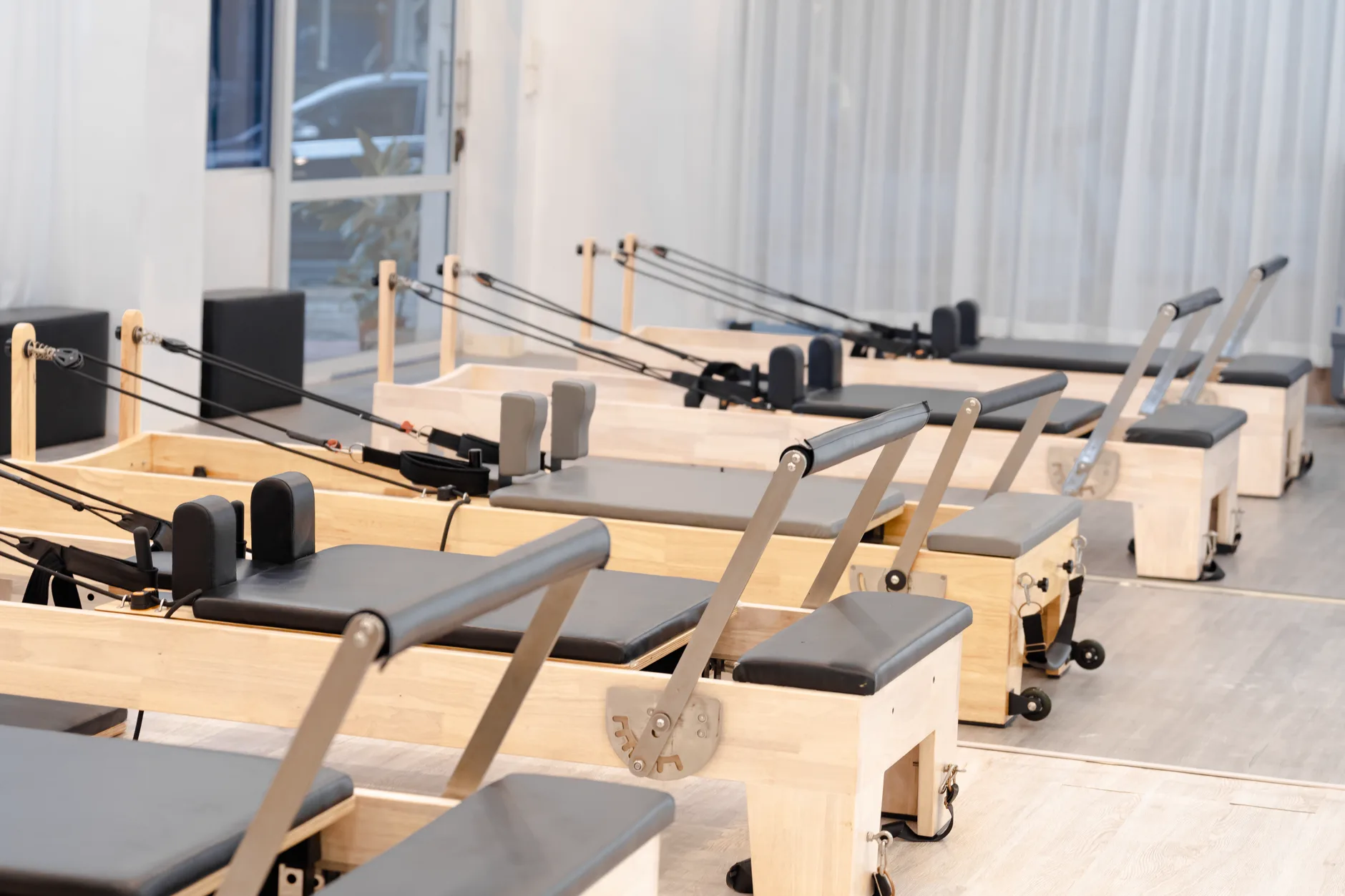
The Two-Picture Franchise: Why 1,029 Studios and −5% Same-Store Sales Can Both Be True at Once
Club Pilates is the largest reformer Pilates franchise in the world by studio count, and its parent company just hired an investment bank to explore a sale. Both facts describe the same business at the same moment.
You are looking at a Club Pilates franchise disclosure document. The numbers are good. 1,029 franchised studios at the end of 2024. Average gross revenue of $984,270 across 849 qualifying locations. A quartile spread of 1.9x — tighter than almost any franchise system we have analyzed on this site. The growth curve is steep and consistent: 660 to 753 to 868 to 1,029, each year adding more studios than the last.
Then you open an earnings call transcript. Same company, eighteen months later. Same-store sales down 5% in Q2 2026. Total revenue down 13% year-over-year. A $17 million FTC settlement. Full-year guidance cut twice. Jefferies hired in April 2026 to run a strategic review — Wall Street shorthand for “exploring a sale.”
These are not contradictory. They are two pictures of the same franchise, taken at different moments, and the pattern they form is one of the most documented phenomena in franchise economics. Understanding it is worth more to you than any single number in the FDD.
Picture A: The 2025 FDD, Describing 2024
The 2025 Franchise Disclosure Document covers the fiscal year ending December 2024. Here is what it shows.
Unit growth:
- 1,029 franchised studios at year-end 2024
- 161 new openings during the year
- Four-year trajectory: 660 (2021) to 753 (2022) to 868 (2023) to 1,029 (2024)
- Zero company-owned studios at year-end (down from 8 in 2022 and 2023)
These are net figures from Item 20 of the FDD. The document as reported does not break out closures, so “161 openings” is the net change, not a statement that no studios closed.
Revenue per studio (Item 19, 2024):
| Cohort | Average Gross Revenue | Median |
|---|---|---|
| All 849 Qualified Studios | $984,270 | $969,022 |
| 1st quartile (top 25%) | $1,305,116 | $1,261,234 |
| 2nd quartile | $1,051,803 | $1,048,027 |
| 3rd quartile | $894,131 | $894,375 |
| 4th quartile (bottom 25%) | $686,457 | $713,766 |
| Expanded Studios (11 locations, >12 reformers) | $1,477,615 | $1,364,420 |
The spread. Top quartile to bottom quartile is 1.9x ($1.31M vs. $686K). For context, the Goddard School’s equivalent spread in its FDD is 11.2x. A 1.9x spread means the difference between a good location and a weak one is roughly a doubling of revenue, not an order-of-magnitude gap.
Fee load. Royalties (8%), brand development fund (2%), and local advertising (the greater of $1,500/month or 2%) combine to roughly 12% of gross sales. The full fee structure analysis breaks it down line by line.
Picture A, taken alone, describes a franchise system that a reasonable investor would seriously consider.
Picture B: 2026 Reported Results
The parent company, Xponential Fitness (NYSE: XPOF), is publicly traded. That means its post-FDD performance is a matter of public record, and that record tells a different story.
The FTC settlement (March 2026). The Federal Trade Commission secured a proposed stipulated order requiring Xponential to pay $17 million in consumer redress. The FTC alleged violations of the Franchise Rule across several Xponential brands, with Club Pilates named specifically. Xponential admitted no wrongdoing.
Operating performance (Q2 2026, per Xponential’s SEC filings):
- Club Pilates same-store sales: −5% year-over-year
- Portfolio-wide same-store sales: −6.8%
- Total revenue: $66 million, down 13% year-over-year
- Adjusted EBITDA: $21.9 million, down 22%
- Net loss: $4.8 million, versus net income of $1.3 million in the prior-year quarter
Guidance cut. Full-year 2026 guidance was reduced to $250–260 million in revenue (from $260–270 million) and $91–97 million in adjusted EBITDA (from $100–110 million).
Strategic review. In April 2026, Xponential hired Jefferies to conduct a strategic review. In public-company contexts this typically means the board is exploring a sale, a merger, or a significant restructuring. The review has not concluded as of this writing.
Picture B, taken alone, describes a franchise system in distress. But it is not a standalone picture. It is what happened after Picture A.
The Pattern: Growth and Decline Are Not Opposites
A franchise system can simultaneously be opening new studios and experiencing declining same-store sales. This is not a paradox. It is a well-documented trajectory that franchise analysts call saturation pressure, and it follows a predictable sequence:
- Format novelty drives early growth. A new concept — in this case, reformer Pilates at accessible price points — enters underserved markets. Early studios perform well because there is little direct competition and significant latent demand.
- Success attracts imitation. By 2024, reformer Pilates represented approximately 27% of new boutique fitness studio openings, per MMCG market data. JETSET Pilates surpassed 400 territories sold. Crunch launched a reformer concept across 20 gyms. The category Club Pilates created is no longer a category it owns alone.
- New openings cannibalize existing studios. Each new Club Pilates in a metro area draws from the same pool of Pilates-inclined consumers. The 161 studios opened in 2024 were largely in markets that already had Club Pilates presence. Same-store sales decline is the arithmetic consequence.
- The parent’s economics diverge from the franchisee’s. Xponential collects franchise fees on every new studio sold and royalties on every dollar of gross revenue. More studios, even underperforming ones, can still grow the parent’s top line for a while. But the individual franchisee does not benefit from systemwide expansion — they benefit from their studio’s revenue minus their costs.
This is the pattern. It is not unique to Club Pilates. It has played out in frozen yogurt, cupcake shops, fast-casual dining, and multiple previous fitness cycles. The question is never whether it is happening — the data above confirms it is — but where in the sequence your specific market sits.
What the Saturation Context Looks Like in 2026
The broader reformer Pilates market is moving fast. MMCG projects reformer Pilates will account for approximately 46% of new boutique fitness openings in 2025, up from 27% in 2024. That is not a sign of category health — it is a sign that the supply response to 2022–2024 demand has become a flood.
Market-level data shows the saturation is uneven:
- California, Club Pilates’ densest market, shows clear submarket saturation. Studios within three-mile radii of each other are common in major metros.
- Secondary and interior markets — mid-sized cities where reformer Pilates arrived later — still show pricing power and less direct competition.
This unevenness is the single most buyer-useful finding in the data. A Club Pilates in Sacramento in 2026 faces a fundamentally different competitive environment than a Club Pilates in Boise or Greenville. The FDD average of $984,270 describes neither of them specifically.
The market and competition analysis maps where the competitive density sits. If you are considering a territory, that is where to start.
Five Questions This Pattern Demands You Answer
If you are evaluating a Club Pilates franchise in late 2026, the two-picture framework converts to five concrete due-diligence questions. Each one requires local data, not system averages.
1. How many reformer Pilates studios operate within a 10-minute drive of your territory?
Count all of them, not just Club Pilates locations. JETSET, [solidcore], Pure Barre (which has added reformer classes), independent studios and big-box reformer programs all draw from the same consumer pool. If the answer is more than three, you are entering a saturated submarket regardless of what the systemwide FDD average says.
2. What is the same-store sales trajectory of the nearest existing Club Pilates?
The system reported −5% in Q2 2026. Your nearest neighbor may be better or worse. If the territory is adjacent to a studio whose membership has been flat or declining, the pool you will draw from is already being competed for.
3. What does your buildout cost look like against the current revenue distribution?
The total initial investment ranges from $385,048 to $839,058, per Item 7 of the 2025 FDD. Against a bottom-quartile gross revenue of $686,457 (2024) and a fee load of roughly 12%, the arithmetic on the low end is tight. Capital advisors like Lendesca can model the debt service implications at each quartile, which is the calculation that separates an informed decision from an optimistic one.
4. What happens to your economics if the strategic review results in a sale?
A change of parent ownership can mean new leadership, new fee structures, new territory policies, or new brand direction. Franchise agreements survive ownership changes, but the practical reality of operating under a new parent can vary significantly. The operations and licensing structure describes what the current agreement governs and where a new owner would have discretion.
5. What is your exit assumption, and does the two-picture reality support it?
A franchise resale requires a buyer who believes in the forward economics, not the trailing FDD. If same-store sales are still negative when you want to exit in year five or seven, your resale multiple reflects Picture B, not Picture A. Price your entry accordingly.
What This Means for a Signing Decision
Club Pilates is not a bad franchise. The 2024 Item 19 data is genuinely strong, the quartile spread is unusually tight, and the format has real consumer demand. But it is also not the franchise described by its growth curve alone. The −5% same-store sales decline, the FTC settlement, and the parent’s deteriorating operating performance are all public information that a prospective franchisee is responsible for weighing.
The two pictures are not a reason to walk away. They are a reason to do your analysis twice: once with Picture A assumptions (stable revenue near the system average, manageable competitive density, a long runway for your market) and once with Picture B assumptions (declining comps, increasing local competition, a parent company undergoing ownership transition).
If the deal works under Picture B, you have found a defensible investment. If it only works under Picture A, you are making a bet that the saturation pattern reverses — and the historical pattern in franchise fitness suggests that bet rarely pays.
The SBA’s franchise lending guidelines require a business plan. Write two versions. The one that survives the stress test is the one worth signing.
All figures attributed to the 2025 FDD describe the fiscal year ending December 2024. All figures attributed to Q2 2026 are from Xponential Fitness, Inc. public filings with the SEC. The FTC settlement is a proposed stipulated order; Xponential admitted no wrongdoing. Franchise Financing Guide is editorially independent of every franchisor named on this site. All trademarks are the property of their respective owners.