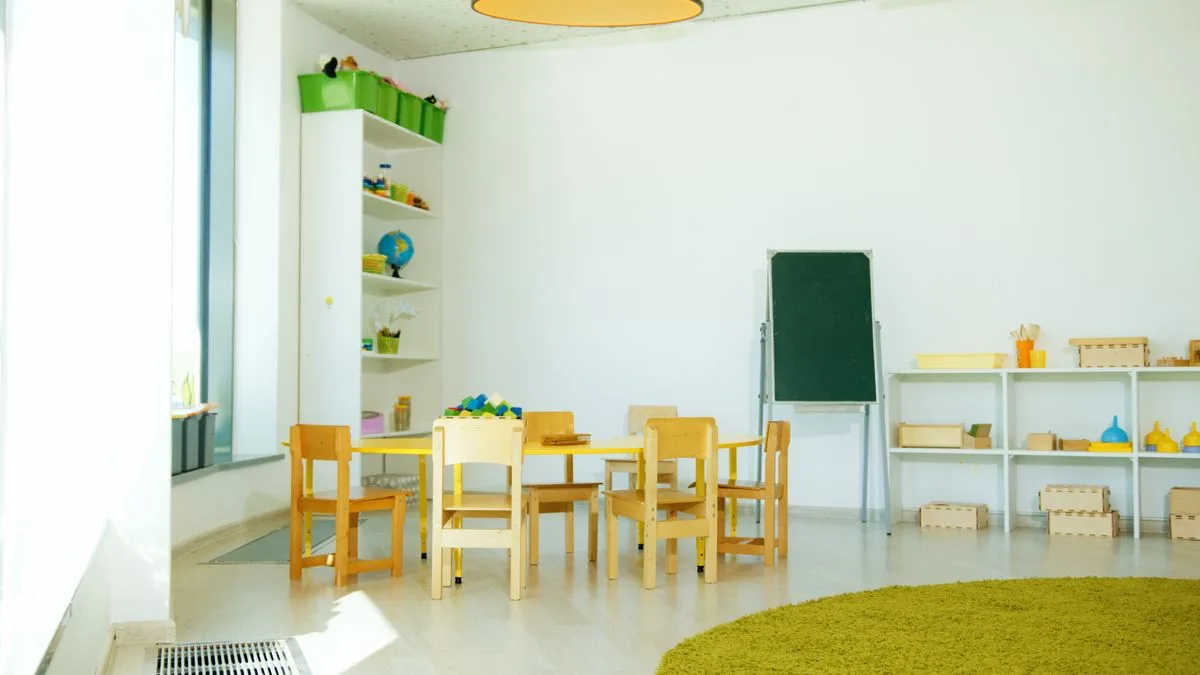
The Universal Pre-K Squeeze: When the Government Competes for Your Most Profitable Age Cohort
You built your pro forma around full classrooms of 3- and 4-year-olds paying $1,400/month. In 22+ states, the government is about to offer their parents a free alternative two miles away — and it targets the exact age group that generates your highest margins.
You’re evaluating a Primrose territory. You’ve modeled the enrollment ramp, stress-tested the revenue quartiles, and validated the demographic density. Everything pencils out.
Then a state legislator announces Universal Pre-K expansion in your metro. A new public elementary school two miles from your site starts offering free, full-day preschool for every 4-year-old. No income test. No waitlist. Free.
This is not a hypothetical. It is happening right now in 22+ states with active Universal Pre-K programs, and the funding is accelerating. The question isn’t whether UPK will reach your territory — it’s whether it’s already there, and what it does to your unit economics when it arrives.
This piece is not about birth rate decline (demand persists despite fewer births). It’s not about pursuing state pre-K contracts as revenue (that’s the opportunity side). This is about the competitive threat: what happens when your premium product competes against a free public option for the same children.
Why the 3-4 Year Old Cohort Is Your Economic Engine
Before you can assess the threat, you need to understand why losing 3- and 4-year-olds is not the same as losing any other age group.
In a typical Primrose school, the age cohorts generate vastly different margins:
- Infants (6 weeks–12 months): State-mandated ratios of 1:3 or 1:4. Three or four staff members for a classroom of 12. Highest staffing cost per child. Lowest margin.
- Toddlers (1–2 years): Ratios of 1:4 to 1:6 depending on state. Better than infants, still labor-intensive.
- Early preschool (2–3 years): Ratios improving to 1:7 or 1:8. Margins begin to turn positive in meaningful ways.
- Pre-K (3–4 years): Ratios of 1:9 to 1:12 in most states. The sweet spot. Higher enrollment density per classroom, lower per-child staffing cost, and tuition rates comparable to younger age groups.
The math is stark. A pre-K classroom with 20 children and two teachers generates roughly 2–3x the margin of an infant room with 12 children and three or four teachers — at similar or higher tuition rates.
According to Child Care Aware of America’s 2024 pricing data, average annual center-based childcare costs range from $10,000 to $17,000+ depending on age and state. But the cost-to-serve ratio inverts at the pre-K level: you charge similar tuition with far lower staffing costs per child.
In a standard Primrose school with 10–12 classrooms, the pre-K classrooms (3- and 4-year-olds) typically account for 30–40% of total enrollment capacity. They are the profit center that subsidizes the thinner-margin infant and toddler rooms.
When UPK pulls families out of those classrooms, it doesn’t reduce revenue proportionally. It strips out your highest-margin seats first.
The UPK Expansion: 22+ States and Accelerating
The scale of Universal Pre-K investment in 2026 is unprecedented. This is not a pilot program in three cities. It is a national policy movement with bipartisan support and substantial funding behind it.
The Big Three
New York has committed $4.5 billion in FY27 childcare and pre-K investment, including 35,000 new pre-K seats. The goal: universal childcare access for all children under four by 2028/29. For any Primrose operator in the New York metro or expansion territories, this is a direct competitive force.
Colorado has expanded its Universal Preschool program with a $14.3 million increase for 2026–27. Every 4-year-old in Colorado qualifies for 15 hours/week of free preschool — regardless of family income. No means test. No income cap. If a family lives in Colorado, their 4-year-old gets free preschool. Primrose has a significant Denver metro presence directly exposed to this program.
New Mexico allocated $474 million to childcare as part of nearly $1 billion in total early childhood spending, funded through the Land Grant Permanent Fund — one of the most fiscally durable funding mechanisms in any state.
The Expanding Middle
Beyond the headline states, the NIEER State of Preschool Yearbook tracks programs in every state. The trend is clear:
- Georgia has operated universal pre-K since 1995. It’s the longest-running program and the best proxy for what mature UPK competition looks like.
- Florida runs Voluntary Prekindergarten (VPK) for all 4-year-olds. Low reimbursement rates, but broad eligibility means significant enrollment capture.
- Vermont offers universal pre-K for all 3- and 4-year-olds — one of only a handful of states covering the 3-year-old cohort.
- Illinois is expanding Preschool for All to full-day programs in the Chicago metro.
- Michigan is widening income eligibility for the Great Start Readiness Program.
- Massachusetts, Oregon, Maine, Maryland — all expanding access in 2026 legislative sessions.
A $560 million federal pre-K expansion is funding programs in 400+ additional schools nationally. Nearly two-thirds of governors prioritized childcare and early learning in their 2026 State of the State addresses.
This is not a temporary funding surge. It is a structural policy shift.
The Enrollment Impact: Modeling the Squeeze
Here is what the UPK squeeze looks like in your pro forma.
Baseline Assumptions
- Primrose school with 200 enrolled children
- 30–40% of capacity (60–80 children) in the 3- and 4-year-old pre-K classrooms
- Monthly tuition: $1,200–$1,600 per child (market-dependent)
- Pre-K classrooms contribute disproportionate margin due to favorable ratios
The UPK Scenario
In a state with mature UPK (free, accessible, no income cap):
- 40–60% of families with 4-year-olds will seriously evaluate the free public option. Census Bureau data on preschool enrollment shows public preschool enrollment has been climbing as a share of total preschool enrollment for over a decade.
- If half of your 4-year-old families leave for the free option, you lose 15–20 children from your highest-margin classrooms.
- At $1,400/month average tuition, that’s $252,000–$336,000 in annual revenue loss.
- As a percentage of the $2.73M system average, that’s a 9–12% top-line hit — concentrated entirely in your highest-margin segment.
The EBITDA impact is worse than the revenue impact suggests. Because these are your best-margin seats, losing $300K from pre-K classrooms hits your bottom line harder than losing $300K from infant rooms would. Your enrollment economics shift structurally.
The Cascade Effect
The damage doesn’t stop at the 4-year-old classroom. Primrose’s enrollment model relies on children entering as infants or toddlers and aging through the system — a natural pipeline that fills pre-K classrooms without acquisition cost.
When families know they can access free pre-K at age 4, some will delay entry entirely. Why pay $1,400/month for a 3-year-old when free pre-K starts in 12 months? Others will enter at age 2 or 3 but plan to leave at 4. Either way, you lose the pipeline continuity that makes enrollment funnel economics work.
The Defensive Pivot Nobody Talks About — And Why It’s Expensive
The intuitive response: if 3- and 4-year-olds are leaving for free public pre-K, double down on infants and toddlers. Build your brand around the age groups the government isn’t subsidizing. Become the premium infant/toddler program.
This sounds logical. The economics say otherwise.
The Ratio Problem
Shifting enrollment emphasis toward infants and toddlers means operating at dramatically different staffing ratios:
| Age Group | Typical State Ratio | Staff Needed for 20 Children | Relative Staffing Cost |
|---|---|---|---|
| Infants (0–12mo) | 1:3 or 1:4 | 5–7 staff | 3x baseline |
| Toddlers (1–2yr) | 1:4 to 1:6 | 3–5 staff | 2x baseline |
| Pre-K (3–4yr) | 1:9 to 1:12 | 2 staff | 1x baseline |
To serve the same number of children in infant rooms as you would in pre-K classrooms, you need 2–3x the staff. State licensing ratio requirements are non-negotiable — these aren’t suggestions.
The Credentialing Gap
Infant and toddler care requires different — and in many states, higher — staff credentialing than pre-K. According to NAEYC accreditation standards, infant/toddler caregivers need specialized training in developmental milestones, safe sleep practices, and responsive caregiving that goes beyond pre-K classroom management.
In a market where payroll already consumes 50–60% of revenue and qualified early childhood educators are scarce, staffing an infant-heavy model is materially more expensive and operationally harder.
The Physical Plant Constraint
Infant rooms require more square footage per child (35–50 sq ft vs. 35 sq ft for pre-K in most states), dedicated diaper-changing and feeding areas, separate napping zones, and different safety configurations. You can’t simply re-designate a pre-K classroom as an infant room without renovation.
The pivot isn’t free. It requires more staff, higher-credentialed staff, physical plant modifications, and a fundamentally different operating model — all while generating lower per-child margins.
Geography Is Destiny: The UPK Threat Map for Territory Selection
The UPK threat is not uniform. It varies dramatically by state, and that variation should be a primary input in your territory selection process.
High Threat States (Mature or Rapidly Expanding UPK)
These states have either mature universal programs or aggressive near-term expansion plans:
- New York — $4.5B investment, universal access target by 2028/29
- Colorado — Income-agnostic universal preschool, 15 hours/week for all 4-year-olds
- Georgia — Universal pre-K operating since 1995; 60%+ of 4-year-olds enrolled
- Florida — VPK available to all 4-year-olds; low reimbursement but broad access
- Vermont — Universal for 3- and 4-year-olds
- New Mexico — $474M allocation with stable permanent fund backing
- Illinois — Expanding to full-day in metro Chicago
If you’re evaluating a Primrose territory in these states, UPK competition is already a factor in your enrollment model. You must underwrite it.
Moderate Threat States (Expanding but Incomplete)
- Michigan, Massachusetts, Oregon, Maine, Maryland — Programs expanding but not yet universal or fully funded
- North Carolina, Virginia — Growing investment but capacity-constrained delivery
In these states, the threat depends on your specific county. UPK seats may be concentrated in urban districts while your suburban territory remains underserved.
Lower Threat States (Limited or Fragmented Programs)
- Texas — Large Primrose footprint, but pre-K is fragmented through individual school districts rather than a statewide universal program. Threat is hyper-local.
- Arizona, Tennessee, South Carolina — Limited state-funded pre-K. The threat is lower today but watch legislative sessions.
The NIEER interactive database lets you pull state-level enrollment, spending per child, and quality standards for every state program. Use it before signing a franchise agreement.
What Primrose Can Do — And Whether It’s Enough
Primrose is not defenseless against UPK competition. The brand has real structural advantages. But those advantages have limits.
The Curriculum Moat
Primrose’s Balanced Learning curriculum is the primary differentiator against free public pre-K. The argument to parents: UPK is free, but Primrose delivers a proprietary, research-backed educational experience with better outcomes.
This argument works — for some families. The ones who were choosing Primrose for educational quality will stay. The ones who were choosing Primrose primarily for convenience, hours, or because it was the best available option may leave when a free alternative appears.
The question is the split. In markets with strong public school systems, the UPK option carries institutional credibility. In markets with weaker public schools, Primrose’s quality advantage is more defensible.
Participating in State Programs
Primrose schools can and do participate in state-funded pre-K programs. Georgia Primrose locations have accepted Georgia Pre-K students for years. This is the revenue diversification strategy — accept state-funded seats instead of losing them entirely.
The trade-off: state reimbursement rates typically cover 60–80% of private-pay tuition. You keep the child, but at a 20–40% discount. Your revenue doesn’t disappear, but your margin compresses.
Extended Hours and Wrap-Around Care
Most UPK programs run 6 hours per day, roughly 8:00 AM to 2:00 PM. Working parents need care from 7:00 AM to 6:00 PM. Primrose can offer wrap-around care — before and after the UPK hours — to families using the public program.
This model exists and works in some markets. But you’re now providing 5 hours of supplemental care instead of 11 hours of full-day care. The revenue per child drops accordingly.
The Due Diligence Checklist: UPK Risk Assessment Before You Sign
Before committing to a Primrose territory, run this assessment:
- Identify your state’s UPK status. Check the NIEER yearbook and your state’s Department of Education for current and proposed pre-K programs. Is there a universal program? Income-targeted? Expanding?
- Map the free seats within your territory radius. How many public pre-K seats exist within a 5-mile radius of your proposed site? How many are planned? Call the local school district. This is public information.
- Calculate your 3-4 year old revenue concentration. What percentage of your projected enrollment and revenue comes from the 3- and 4-year-old classrooms? If it’s 30–40% of enrollment but 40–50% of margin, you have concentrated exposure.
- Model the enrollment loss scenario. Run your pro forma with 25%, 50%, and 75% of your 4-year-old classroom shifting to UPK. At what point does the school fail to hit break-even?
- Assess the infant/toddler alternative. If you need to shift enrollment emphasis to younger age groups, model the staffing cost increase. Use your state licensing ratio data for precise numbers.
- Evaluate state program participation. Can your Primrose school participate in the state UPK program? At what reimbursement rate? Model the margin impact of accepting state-funded seats at 60–80% of private-pay rates.
- Check the legislative calendar. Even if your state doesn’t have universal pre-K today, is legislation pending? A bill introduced this session could be law by Year 3 of your franchise term.
The Bottom Line: This Is a Territory Selection Problem, Not a Business Model Problem
Primrose is not going to collapse because of Universal Pre-K. The brand is strong, the curriculum is differentiated, and infant/toddler care is genuinely hard to replicate in a public setting.
But UPK creates a measurable headwind that varies dramatically by geography. A Primrose school in a Texas suburb with no state UPK program faces a fundamentally different competitive environment than one in a Colorado suburb where every 4-year-old already has access to free preschool.
The operators who thrive will be the ones who:
- Selected territories in states with limited or no UPK competition
- Built enrollment models weighted toward infant/toddler care (and priced accordingly)
- Participated strategically in state programs where reimbursement rates are viable
- Used the Balanced Learning curriculum as a genuine quality differentiator rather than a marketing talking point
The operators who struggle will be the ones who underwrote a territory assuming 100% private-pay 4-year-old enrollment, then watched a free public option open within a 3-mile radius of their school.
This is knowable risk. The data is public. The programs are published. The funding is committed. The only question is whether you build it into your model before you sign — or discover it after.